Tuesday, November 28, 2017

Who Doesn't Love Cameos

The cameo is perhaps one of the most recognizable designs in the world of jewelry with roots dating back all the way to the time of the ancient Greeks.  However, while the design is thousands of years old, there are no known examples of cameo jewelry past the time of the Romans.

But today, the market is literally flooded with thousands of vintage cameos from the 19th century.  Napoleon helped renew the popularity of the cameo design when he wore a coronation crown studded with the ornately crafted design.  Popularity reached its peak in the Victorian Era with the queen herself actually known to have designed a piece or two in her day.  Today, the ubiquitous design can be found on virtually every type of jewelry, including:
  • Lang Antiques
    Watches (not familiar with this style)
  • Earrings (very popular)
  • Rings (everybody loves the rings)
  • Bracelets (work well with a set that includes earrings, maybe a brooch)
  • Brooches (cameo brooches seem abundant)
  • Necklaces (can't resist admiring them in a showcase)
  • Chokers (this is my personal favorite style) 
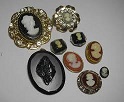
By and large, a cameo can be identified by the portrait which adorns each and every piece and this should be the starting point for any value determination.  Set upon a flat plaque, the portrait really is critical to value determination. Cheaper cameos will have a molded portrait while your more valuable pieces will be carved. Common characteristics of the really cheap molded versions are:  light weight, shiny, and blended colors. There are some examples, however, of natural materials being used in molded versions.
Although there are a few exceptions, molded pieces should actually be avoided at all costs. Separating the good-looking knock-offs from the real deal is the key to collecting for profit. Mold marks or ridges of some kind will be found on the back of your cheaper glass cameos. Although the imitation pieces can be of exceptionally high quality, it is possible to identify them by carefully studying the portraits.
Carved pieces tend to command greater value because the materials are more valuable and they are far more expensive to manufacture. Many valuable cameos are carved out of shells but their plastic imitators are so good these days that it almost takes a jewelry expert to identify the valuable carved versions.  You are looking for the shell cameos featuring a pair of colors, precise carve lines, and a thin back.
Other materials commonly used to create the more valuable cameos are abalone, mother-of-pearl, and agate.  Abalone and mother-of-pearl carved cameos also have great detailing but will tend to be thicker and have a flat back when compared to the shell versions. Relatively flat and multi-colored due to its layering, agate is a very popular material used to make some of the more valuable carved cameos.
But at the end of the day, the really valuable carved pieces will be made from stone, which can sometimes be imitated quite well using glass. The only way to really separate the glass imitators from the real stone pieces is to look carefully at the space between the portrait and flat plaque. Unlike the glass imitators, the stone pieces will be under-carved at the point where the plaque and portrait meet. The stone pieces are gems in the cameo collecting world but they are rare so be careful not to be fooled by an imitator.


Author:
Jon Kreps specializes in vintage costume jewelry collecting whose site can be found at: www.vintagetemptations.com

Note from Anywear Jewelry:
Vintage Temptations is the perfect name for the authors website. The items for sale are extensive and they are just not for jewelry. Collectibles galore!!! The prices seem fair too. Check it out when you get the chance.

Friday, October 13, 2017

Aries, Taurus and Gemini Magic Stones, Birthstones And Colors

Aries
Mars is the red planet and the ruling planet of Aries. Blood stones, rubies and garnet are excellent fiery choices. Red is the color of love, fertility and energy. Red keeps you alert, provides courage and calls for action. Taking your fire down a notch can be done with carnelian. Carnelian promotes peace, harmony and patience while holding on to fire and gives warrior energy to the wearer.

Wearing red will increase your temperature and body heat. It is linked to raising blood pressure and circulation. It is ideal for someone that is anemic but not so good for someone with high blood pressure. Red acts as a stimulant. It releases adrenaline into the bloodstream. Red detoxifies and is know to help fight infection.

The traditional birthstone is a diamond. Diamonds are known for purity and Aries energy is pure, uncluttered by hidden motives. Herkimer diamonds can be substituted if your budget does not permit the more expensive.

Taurus
Pink is less active and aggressive than red and has an endearing quality. A Taurus desires domestic bliss and unconditional love seeks affection that this color's ray provides. Pink gives a soothing and comforting vibe. It protects and brings peace of mind. Especially helpful when grieving the loss of a loved one.

The traditional birthstone of Taurus is Emerald and the ruling planet is Venus. Emeralds represent the Earth element and Venus. This stone is most powerful when set in copper, the metal that corresponds with Venus.

A great big chunk of polished perfect rock - of any kind will suit you just fine, too. Another stone that is good for you is lapis. That gorgeous blue stone that is laced with flecks of gold and Jade.

Gemini
The ruling planet of Gemini is Mercury. The agate is your birthstone as well as the stone representing Mercury. Your love for variety makes a lot of sense now. Agate is an aid to truth-telling and good to carry with you when you want your words to be right.

Even though Flourite is not traditionally associated with Gemini, some astrologers think it is a perfect match because it is connected to the air element. It keeps the mind sharp. Keep it close enough to your computer to grab it when you get writer's block.

Yellow signifies agility of intellect and inspiring thought. If you are feeling down or a little bit shy, wear yellow to bring feelings of optimism. Yellow eliminates waste from the body, as well as clears emotional baggage. Wear shades of yellow to control your weight. It has also been known to help in the treatment of eczema and other skin irritations. Yellow aims for a correct balance of liquids in the body.


Next post includes Cancer, Leo and Virgo...


Monday, August 14, 2017

Must Read For Vintage Jewelry Collectors


Tube style catch was patented in 1850.

Rarely found in a piece of jewelry, but it's good to know, aluminum was first displayed in 1852.
Celluloid was invented in 1868.

In 1894, screw back earrings were patented. Clip on style came later. The wire, some call fish hook style earrings have been around for a long time.

Jewelry marked with the letters R,G.P after a number (karat sign) represents "rolled gold plate." Very popular during the 1800 s and early 1900 s. 

Sometimes G.F. will be found next to the karat sign and this represents "gold filled." Which is not filled with gold at all. It is actually plating and the layer of gold is usually thinner than the former. The marking might include a fraction before the karat sign. For example: 1/20 12 K. This means the plating is 12 Karat or 50% pure gold and 1/20 of the total weight is 12 K gold.

There is another marking that can be found stamped inside a piece of jewelry that also represents plating, H.G.E. The initials stand for hard gold electroplated. An electrical process was used during the plating of gold to this piece of jewelry.

In the late 1800 s, many pieces of jewelry were stamped "solid gold" or advertised as such, when the gold content was actually only 6 K or 10 K. In 1906, a law was passed that required the actual gold content be stamped on all jewelry. Before 1906, a lot of gold jewelry was not marked.

Pinchbeck is a very old metal made by mixing copper and zinc and looked a lot like gold. Christopher Pinchbeck (1670 - 1732) invented this gold look-a-like that wore well. The owners of real gold jewelry, during that time, had copies made in the metal to wear when traveling. They would leave their valuable possessions safe at home and avoid losing them to thieves along the way that prayed on travelers. The 1840 invention of the electro-gilding process as well as the legalization of 9K gold in the 1850 s, meant the use of pinchbeck was no longer needed. This type of metal is rarely seen today.

Hope you find this information useful. Next post contains similar info on silver and other metals.

Leave a comment with more information, or questions, or links are welcome too, as long as they are related to the contents of this blog.