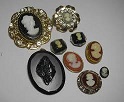
Wearing Your Jewelry
 Long drop earrings give the illusion of length to your face. So they're a great thing for those who have chubby cheeks or maybe a double chin.
Perfume oils will discolor gold, pearls and other gems. Don't spray perfume over your jewelry. This goes for hair spray too. This can easily be avoided by putting your jewelry on after you are completely dressed with hair and makeup in place.
Cleaning Your Costume Jewelry
 Jewelry made with some stones and with imitation gold & silver can be washed in mild dish washing liquid and warm water. Wash in bowl not sink ( you don't want to take the risk of losing something down the drain). Individual pieces of jewelry should not touch each other in solution so as not to scratch. After soaking for a minute, brush individual piece with soft toothbrush and dry with chamois cloth or facial tissue. Before you dump left over solution make sure to check the bowl for lost pieces. DO NOT use bleach because it will damage metal mounts beyond repair.
Special Treatment Required
Ivory - Dust ivory pieces regularly with soft cloth; using a clean, soft toothbrush to reach into carved areas. Sunshine keeps ivory from yellowing but too much sun can cause ivory to crack. Perfume and hair spray can cause discoloring.
Jade - Combine 1 tablespoon ammonia and 1 cup hot water. Swish jewelry briefly and dry immediately with soft cloth. Jade scratches easily.
Jet - Never soak in water or any type of chemical solution. Just wipe with damp soft cloth.
Diamonds - Swish these stones briefly in 1 tablespoon ammonia and 1 cup hot water. Then dip in rubbing alcohol and pat dry with tissue paper.
Long drop earrings give the illusion of length to your face. So they're a great thing for those who have chubby cheeks or maybe a double chin.Perfume oils will discolor gold, pearls and other gems. Don't spray perfume over your jewelry. This goes for hair spray too. This can easily be avoided by putting your jewelry on after you are completely dressed with hair and makeup in place.
Cleaning Your Costume Jewelry
Jewelry made with some stones and with imitation gold & silver can be washed in mild dish washing liquid and warm water. Wash in bowl not sink ( you don't want to take the risk of losing something down the drain). Individual pieces of jewelry should not touch each other in solution so as not to scratch. After soaking for a minute, brush individual piece with soft toothbrush and dry with chamois cloth or facial tissue. Before you dump left over solution make sure to check the bowl for lost pieces. DO NOT use bleach because it will damage metal mounts beyond repair. |
| Absolute Clean Online |
Ivory - Dust ivory pieces regularly with soft cloth; using a clean, soft toothbrush to reach into carved areas. Sunshine keeps ivory from yellowing but too much sun can cause ivory to crack. Perfume and hair spray can cause discoloring.
Jade - Combine 1 tablespoon ammonia and 1 cup hot water. Swish jewelry briefly and dry immediately with soft cloth. Jade scratches easily.
Jet - Never soak in water or any type of chemical solution. Just wipe with damp soft cloth.
Diamonds - Swish these stones briefly in 1 tablespoon ammonia and 1 cup hot water. Then dip in rubbing alcohol and pat dry with tissue paper.
Interesting Jewelry Facts Not Well Known
- Only one natural pearl will form out of every 10,000 oysters. That's it.
- 100,000 year old beads made from Nassarius shells is officially known as the oldest ever found
- Americans spell it jewelry, everyone else spells it jewellery.
- "Jewel", from the old French jouel, which comes from the latin jocale, translation - plaything.
- For the past 100 years Africa has been the top producer of gold.
- The #1 producer of silver is Mexico. A close second is Peru.
- Real Amber, fossilized tree resin at least a million years old, will float in water.
- In Asia, the Middle East and Africa, 24K gold is used in the making of jewelry.
- In the USA and across Europe, most jewelers believe 24K is too soft for jewelry making.
- A large, perfect, gem quality ruby is worth more than a diamond the same size and quality.
- Peridot, Lapis Lazuli and Pearls were ground up and used as eye shadow in ancient times.
- Naturally colored diamonds are extremely rare. The most expensive and rarest are red, purple and then pink. Their white cousins are abundant and cost considerably less.
- Burma Rubies are not allowed out of Burma. These rubies are quite valuable and can only be purchased on the secondary market.
- Live insect jewelry was popular at certain times in history. You heard me right. Egyptians wore scarab beetles into battle. A Mexican Maquech Beetle and the Giant Madagascar Hissing Cockroach were also used in jewelry. Victorians in Britain could often be seen sporting live beetles attached to their clothing by tiny, fine gold chains.