Wednesday, August 27, 2014

A Must Read For Vintage Jewelry Collectors

Whether your a beginner collector or experienced, you will find value in this article.  Follow the link to their resource and you will find the next book I will be purchasing.

The information found here is just an appetizer.  The main course is sure to delight.  Check it out.  You won't be sorry!

"Antique and estate pieces of great value have been lost to the scrapper because neither seller, nor buyer, realized that the item had value beyond its metal weight."  I couldn't have said it better myself.  This comes from Skinner Auction House blog.  This article is an eye opener.  

Skinner has many links included that you will want to follow to get even more valuable information.  If you have jewelry that you need to be checked out, use this form

If you saw this piece of jewelry at a garage sale would you buy it?  Well that's where it was found for only $5.00.  Made from a single piece of wire including the pin part.  Awesome! 

 "Skinner subsequently handled the brooch’s authentication by the Calder Foundation, whose experts dated it to 1942. The brooch brought $33,000 at auction, well beyond its value as a few ounces of silver." 


Sunday, July 13, 2014

Difference Between Jewelry Maker's Marks and Hallmarks

     I guess I never really thought about there being a difference before.  The more I research each piece in my collection, the more I learn there is a lot more to learn.  No one could possibly know it all, right?  Besides it is a lot of fun when I discover another piece to the puzzle.  Even if it means I have discovered there are a lot more pieces yet to be discovered.
     This is what I found on my journey today... While researching this gold tone crown pin/brooch marked "Paquette" from my collection, I was led to an interesting website that I plan returning to over and over.  The title of this great discovery?  The Jewelry Loupe, (a celebration of human ornament).  (I wish I would have thought of that.)  You'll find all kinds of useful information Cathleen McCarthy has included on her website for us jewelry junkies.  I love it and I think you will love it too. You'll find out where to get educated in the trade, what they are wearing on "The Good Wife" TV show (not to mention the red carpet) as well as some basics like how to buy a jewelry loupe.  Maybe you would like to know how to wear jewelry like a rock star.  You'll find all this and more, lots more.  Here's a teaser from the site, but you will want to check it out for yourself in all its glory.

What you need to know about jewelry hallmarks
May 6, 2010
By 
Buying antique or vintage jewelry means first figuring out what it is, where and when it was made, and by whom. That’s why the first thing an experienced buyer will do is hold a piece up to a loupe and examine it for hallmarks. If jewelry has hallmarks and they appear authentic, identifying its value is a whole lot easier.
But many countries – including the U.S. – do not have an official hallmarking system and the hallmarks of one country can vary dramatically from another. How does a budding collector begin to unravel this puzzle?
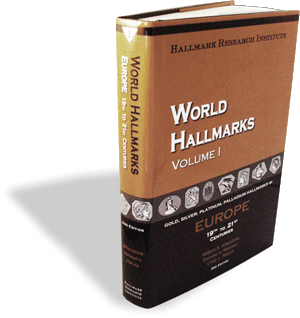
A trusted dealer can help but if you want to learn to identify jewelry on your own, you’ll need a good guide. There are a few books on the market, but if you want the ultimate, illustrated reference book, be prepared to shell out a couple hundred bucks for World Hallmarks: Europe 19th-21st Centuries, due out in its second printing this month. As co-author Danusia Niklewicz puts it, “This book will pay for itself with one correctly identified piece.”
I recently spoke to Niklewicz and William Whetstone, who compiled this tome with fellow appraiser Lindy Matula, about the basics of hallmark identification.
Is it common for people to confuse a maker’s mark with a hallmark?
- See more at: http://thejewelryloupe.com/jewelry-hallmarks-ultimate-consumer-protection/#sthash.sl6ksAEP.dpuf

Wednesday, June 18, 2014

DIY Cleaners For Any Type Metal Jewelry

Air and water oxidize metals and can make them dull.  Keep them looking new with periodic cleaning.  Save money and the environment by making your own inexpensive jewelry cleaner.


Basic recipe for cleaning jewelry
* 1 tbsp dish washing detergent
* 1 tbsp baking soda
* 1 tbsp household ammonia
* 3 cups warm water

Combine ingredients in a bowl and mix well. Pour into a glass jar and cover tightly. Label jar for future use and keep out of reach of children. To use, soak jewelry in the solution for 1-10 minutes (depending on how tarnished it is). Swish intricate pieces in the solution to get into the cracks and crevices. Use a toothbrush or a well-washed mascara brush for hard to reach places. Rinse and dry with a soft clean cloth.

Don’t soak pearls in this solution.
Instead, rub them gently with a soft chamois cloth dampened in the solution.
Pearls will dissolve  in vinegar.
Do not combine this solution with chlorine bleach – hazardous fumes will result!

CLEANING GOLD JEWELRY
Pour cider vinegar in a shallow glass container. Place gold jewelry in the vinegar so that it is covered completely.  Keep all pieces separated.  Nothing should be touching.  Let the jewellery sit in the vinegar for 15 minutes. Remove the jewelry and wipe clean with a soft, clean cloth. The gold should be completely clean.

CLEANING SILVER JEWELRY
1. Line a glass bowl with aluminum foil, shiny side facing outward.
2. Place the jewelry you want to clean in the bowl making sure it’s touching the foil
3. Cover the jewelry with baking soda – just enough so that you can’t see it.
4. Add boiling water – enough to immerse the jewelry.
5. Let soak for 3 to 5 minutes ( or less if it’s not really dirty).
6. Use tongs or a fork to lift out the jewelry ( you don’t want to get burned) and rise under cold water. And voila ………. you have sparkling jewelry.
If the jewelry is very dirty or very tarnished, then you may need to repeat the process.  Just add a little more baking soda and more boiling water.  Making sure the water is boiling is the secret, if there is one. This method works great on sterling, silver, gold and costume jewelry metals.  But do be careful if there are crystals glued into a setting and limit soaking.  No more than 90 seconds or you might melt the glue. Also, don’t immerse natural pearls in this solution - it’s too caustic. It is however, fine for most gemstones and works wonders on cubic zirconia And in case you’re wondering ….it also works fab for cleaning silverware, silver frames or any silver home decor.

If you don’t have aluminum on hand, you can use white distilled vinegar. Mix 2 tbsp. baking soda in 3.4 fluid oz. or almost 1/2 cup (100 ml) of vinegar. Soak silver items in the mixture for 10 minutes. Rinse thoroughly with water and dry the items with a soft, clean cloth. Repeat if necessary

CLEANING COPPER, PEWTER & OTHER METALS
Dissolve 2 tsp. of salt in a cup of white distilled vinegar. Place a few tablespoons of flour (any kind) into a shallow container. Add some of the vinegar mixture to the flour until it forms a paste. Spread a thick layer of the paste on the metal that needs to be cleaned. Let stand for 15 minutes. Scrub clean with a soft, clean cloth.

CLEANING PLATINUM JEWELRY
The way to clean platinum is to make a mixture of half ammonia and half water. Let the platinum soak in the mixture and then polish with a soft cloth. Be careful if the jewelry contains gemstones. The mixture may discolor or harm gemstones except diamonds.  This mixture is not harmful to diamonds.