Showing posts with label jewelry resources. Show all posts

Thursday, January 16, 2020

Don't Assume Anything When Evaluating Jewelry

image picjumbo
Even the experts have to look closely when examining jewelry. They look to see if there are markings of any kind stamped usually out of sight. The mark can tell a lot about the item. Sometimes the metal content will be revealed, the maker, where it was made and sometimes when it was made.

Wait just a minute. Don't assume just because you can't find any visible marks that it is not valuable. I myself have found a solid gold piece that was not marked, in a thrift store.

I have also found items that were marked gold but were not. Crooks will not stop at anything to get your money. Be aware. Don't assume. Don't invest any money that you can't afford to lose. That would take all the fun out of it. Use common sense. I promise you will come across a treasure of your own some time if you havn't already.

There can be significant value in a well made piece of costume jewelry by the right maker with or without marks also. That is why it is so important to do your research.

I've put together a list of some tips that will be useful on your hunt for treasure.
image pixabay
  • Take your tools like a magnifier or magnet with you when shopping second hand.
  • Waiting for a sale can be profitable on silver and gold pieces of jewelry at the thrift store. D.A.V. thrift stores in my area have 1/2 price sales.
  • Make yourself familiar with the different markings for gold and silver. There are many to consider. Sterling, plated, HGE, 10 K, Plat, Vermeil, etc. 
  • Glass is cold to the touch at first but will warm in your hand as you hold it. 
  • A semi-precious stone will stay cold to the touch.
  • If an opal looks too perfect it is faked. Same size, shape and color in the flecks is a dead give away it's faked. If there are gaps evenly spaced, more than likely fake.  
  • Opals come from Australia. A country of origin mark is a clue for dating purposes.
  • Knowing laws and when they were implemented helps to date items. 
  • Learning when a certain technique for jewelry making was invented will help date an item.
  • Aurora Borealis aka AB was invented by Swarovski and Christian Dior in the 1950's.
  • Russia and Hong Kong create a large amount of synthetic stones.
  • You never want a cloudy gemstone. The richer the color the better.
  • Look at the metal setting around your gemstone. If it is super fancy and outshines your gemstone, it could be over compensating for some where it is lacking. Might be a fake stone. 
  • A real diamond does not fog but fake will.
  • Check weight. A heavy solid construction usually indicates an older more valuable item. But not always.
  • When you look at the back of a piece of jewelry, is it many settings or one solid setting. Separate settings is what you want. If you can look at the back and see that it is just as beautiful as the front you know you have got a really nice piece very well made. 
  • Gold and silver are never magnetic and do not turn skin green.
  • Look for any worn spots that show a different color metal underneath.
  • Learn what tarnished silver smells like. Seriously.
  • The facets will be cut sharp when the stone is authentic. If facets are rounded not so much.
  • The corners or edges of gold jewelry are never sharp. Gold is too soft to form a sharp edge.
  • Mystic topaz and Rainbow topaz are the stone. Vacuum disposition is the treatment used to enhance a clear topaz that is an actual semi-precious stone. 
  • Lots of gemstones are "treated" "enhanced" "heated" or what-not.  
Some of these tips I was aware of already but I have been watching a very informative Dr. Lori on you tube lately. You should check her out. She is smart about all antiques. She educates as she appraises and spices it up with a unique sense of humor that's down to earth. She also has a website packed with tips. https://www.drloriv.com/

I guess my final tip for this post would be to keep educating yourself. Don't be afraid to make a mistake because that is how we learn. Happy hunting! 

Thursday, August 29, 2019

Clues For Dating Vintage Earrings Hallmark Mistakes Cost Money

Something to add to your detective toolbox. What the hell am I talking about? You'll see. Read on!
Helpful clues when determining the age of vintage earrings is knowing how they attached to the ears and when that attachment was invented.

               circa 1800 shepherd hook wire
               circa 1873 no name given for this style (hard to explain)
               circa 1882 kidney wire
               circa 1894 screw back (pierced)
               circa 1900 lever back
               circa 1909 screw back style #2 (piercing not necessary)
               circa 1929 post & butterfly
                                  circa 1934 spring clip better known as Clip On
                                  circa 1960 omega back


Earrings have a history way before what is listed above. Earrings have been worn by both men and women. Sometimes worn to reveal your status in the community or mark a specific accomplishment. Sometimes worn as a fashion accessory. The hair and clothing styles of the day often dictated the practicality of wearing earrings at all. 

With that being said, I should not have to tell you that it all comes down to your own personal style. Whether you choose to wear what is currently trending or prefer to be on the cutting edge, be yourself and the best you will shine too.
Mark found on jewelry: AK 14 k "It has nothing to do with gold plating" e-bay seller.

It was my understanding for a long time that AK 14 k stamped on jewelry from Turkey meant your item was gold-plated. I stand corrected. Further research has revealed the AK represents Atasay Kuyumculuk. This is a well known jewelry manufacturer in Turkey. They exported a lot of jewelry to the United States over the years. Nothing to do with gold-plating. They say the word "Turkey" is commonly included in the mark. For example: AK Turkey 14 kt.

AK is also the mark for the manufacturer, Armin Kurz, in Switzerland. The e-bay seller goes on to say that Armin Kurz only deals in 18 k gold jewelry. Here's a link to the conversation on ebay. The posters seem to know what they are talking about. The fact someone commented about the gold plating idea and got shot down helped to convince me.
What does the PL stand for in the marking 14 K PL? Platinum? Plated?
If you find this marking,14 K PL, don't mistake it for "plated" like I have. The "PL" actually stands for "plumb" or full weight. Instead of weighing 13.5 for instance, the item is the full weight at 14 K.

If you find this marking 14 K PL, don't mistake it for "plated" like I have. The "PL" actually stands for "plumb" or full weight. Instead of weighing 13.5 for instance, the item is the full weight at 14 K.

The lesson to be learned here is no matter how much you think you know, you should never stop learning and updating that knowledge.

Here's one more tip to keep you tuned in.
If you have a piece of silver jewelry marked with 925, you can be absolutely sure that it is not a native american piece of jewelry. They might not have used a 925 marking to represent silver, but the word "sterling" was used often by the native american. Good to know.

Tuesday, March 19, 2019

Jewelry Marks From The Past You Need To Know

Markings on jewelry can be hard to decipher. Markings include facts about your item you need to know like gold content, who made it or whether or not its plated.  I think most people are familiar with the traditional 14 K means 14 karat gold. This format for gold content is easily recognized by most of the world. Marks that are forged on either side of the 14 K are not so easy to decipher. Oh no! I was thinking the P L stood for plated. Or was it platinum? Somebody is going to re-examine her jewelry inventory.

14 K P L  = 14 karat gold plumb (full) originated from a system that accepted 13.5 karat weight as 14 karat weight. Many jewelers would add the "P L"to inform customers the quality of their product.

While searching for information pertaining to "filled" verses "plated" I found this post on Specialty Metal's blog.  Even if Barry Lenson wrote the post in 2014, the information is timeless. I have never seen an expiration date forged into a piece of jewelry. I have not conducted any business with this company, but I can tell you the site is user friendly and professional looking. Nothing flashes, pops or talks which is a huge plus in my book.

Click on the link above to read about vintage items (over 20 years ago) and their gold content. Things like trophies or commemorative items, eyeglass frames, cutlery, candlesticks or gold filled dishes among other items have a bigger gold content compared to the gold plated items of today. Who knew? The following are examples of the markings found on gold filled items from the past and what it means.
1/10 10 K means one tenth of the weight is 10 K or 10 karat gold.
1/10 12 K means one tenth of the weight is 12 K or 12 karat gold.

In my notes I found a few more markings and their meanings. Plus very useful tips for deciphering those marks. For instance, any 3 digit number stamped on a piece of jewelry is referring to purity of the metal that your piece is made of. 

Fineness
Karat
Gold Percentage
333
8 K Gold
33.3%
375
9 K Gold
37.5%
416 or 417
10 K Gold
41.6% +
583 or 585
14 K Gold
58.3% +
750
18 K Gold
75.0%
916 or 917
22 K Gold
91.6% +
999
24 K Gold
99.9%
Table of corresponding gold markings, and the gold purity they signify.
This chart was copied from Bellatory I just discovered this site too. It is a forum type of site with post written by the experts. The overall theme is beauty. If you decide to check out the entire site, let the rest of us know what you think about it in a comment.

A few more from my notes:  

AK 14 K  - "AK" is Turkish for "altin kaplama" which means "gold-plated" in the Turkey language.

From 1838 - 1919 a horse's head struck in solid 18 K gold jewelry and watches represents France.

14 K S means 14 K gold-plated over silver.

14 K C H usually means 14 K gold plating over copper.

Monday, January 21, 2019

More Secret Treasure Found

Oh yes, there's more...

The only thing that's missing from Antique Jewelry University, as dynamic as it is, are any mention of current values. That's where Lang Antiques (the mother ship) might be of interest. Here's a link or you can go directly from the Antique Jewelry University. High-end gorgeous pictures of gorgeous items for sale can be found on this simply elegant website. User-friendly and well-organized makes it a stress-free place to visit on the Internet. No pop-ups to ask for your e-mail, remind you to sign in or force you to buy/donate (same thing really). And no survey to take either. Take a peek. Looks like it's unanimous. This ostrich? pretty sure. Funny to me! And this doggy such a sweetie! Always Love Me Kitties! Picture number 2 is freaking me out. Funny? Yes or no, leave in a comment, please.


You really should take a peek. Wow! is all I'm saying. Just one more, Wow! I got inspired to create something on my own. There are many slide shows available to view for FREE.  Lang Antiques is an all-around class act. Need I say more.
*TECH TIP*
Use the arrows, top right of the page to view full screen for maximum entertainment of the slide shows. Would you rather read the book or go see the movie in a theater? You can toggle back and forth if your answer to the previous question was both.

*FYI*
The Antique Roadshow has a data base of every appraisal done on their show.  Just picking a category works but there's an option to narrow it down to specifics about your search.

This valuable resource is often overlooked. Magazines are packed with inspiration, websites, links, ideas, motivation, pictures, supply, opportunity, designers, fashion, trends and more like contests, letters, advice and more. 
It's not all about jewelry. There are a lot of jewelry posts and just about any other subject you can think of posts. with what could be the ONE. I can't  remember how exactly I found this site, other than my usual jumping from link to link like I do. I struck gold on this one and so will you. Bookmark it I got another one to tell you about.
Another great site with numerous categories. Lots of good advice, referrals, etc. .

Questions are asked and answered by the community. The layout is quick and easy to read. It has so much more depth of information than the menu implies. Dig in! Here's a link to the contests page. Win 50 bucks by submitting a tip, or answering a few questions Excellent resource for links that would not get discovered with a simple google search.

-----     ----------      ----------      -----------     -----     
An update to my sidebar link list is long over due, don't you agree? I will be returning to all of them, posting any worthwhile info I find. I want to know how to find them again.


Tag, your it.     Leave a comment letting me know your favorite site.  

Saturday, September 1, 2018

9 Clues for Dating Vintage Costume Jewelry


Treasure Chest Chest Jewellery Open Lighti

These 9 tips will help you distinguish between the old and new costume jewelry pieces out there for sale. A hands-on approach is the best way to learn. Don't you agree? Don't forget to take your magnifier when you go out treasure hunting. I have a little black light that I take along with me. This trick will bring to light glue spots, repairs, cracks and even help when you are trying to figure out if it includes a real semi-precious stone.

I am assuming that you already know to look for a maker's mark, hallmark, metal mark of any kind. These can be your best clue. But you know that already, right? Unsigned pieces are collectible too. It has not always been a requirement for jewelry to be stamped with the gold, silver or platinum content like it is today. And it is still not a requirement that the maker sign each piece of jewelry. Learning and discovering the details is part of the fun when collecting vintage costume jewelry.

  • Prong-set rhinestones represents quality in vintage jewelry.
  • Authentic vintage jewelry most likely will show signs of wear especially on the clasp.
  • 1955 is when copyright symbols first appear on jewelry.
  • Aurora Borealis rhinestones were not introduced until after the war in the mid 1950's.
  • The textured metal on the back of vintage jewelry is not as old as the smooth surface.
  • The sharp end of the pin stem that secures a brooch is longer on older pieces of jewelry. 
  • Older jewelry will be heavier and the construction more solid.
  • Something I have noticed is that newer jewelry is more likely to have sharper edges. 
  • When a "plastic" piece of jewelry is in question, a mold line can be a clue.


Colorful Stone Rings Cabochon Gemstones Ge


Pixabay has awesome free images of jewelry.

Love to Know has a lot of good info about collecting vintage costume jewelry.

The Spruce is another great resource for info. Don't forget to check out the links.

Invaluable is a recent discovery but I can tell it's going to be useful

Gemstone Rings Gem Stone Jewelry Lot Bunch


Really digging these rings! Leave a comment with your tips!

Friday, May 19, 2017

Metal Identification Marks On Jewelry Defined

Gold
K = Karat
KP = Karat Plumb (exact amount of gold)
K.P. = Karat Plate
GF = Gold Filled (heavy plating), usually has a fraction, i.e., 1/20 10K GF
GS = Gold Shell
HGE = Heavy Gold Electroplate
Decimal equivalents of karat ratings:
.375 = 9K (England and Canada)
.417 = 10K
.500 = 12K
.583 (.585) = 14K
.625 = 15K
.667 = 16K
.750 = 18K
.833 = 20K (Asia)
.917 = 22K (Asia)
.999 (1000) = 24K pure gold
Silver
925 (.925) = Sterling
925 NV = Nevada Silver, made in England, electroplated nickel silver
835 (.835) = a lower quality of British Sterling Silver
Sterling
Taxco
MEXICO
STER
.999 Fine = Pure Silver
Platinum
Pt (atomic symbol)
Irid. Plat.
Pt 900
Pt 950
PLAT
Other
316L = High-grade Stainless Steel

Thursday, May 11, 2017

9 Facts About Aurora Borealis Antique or Not.


It's not uncommon to find "antique" in the description of a piece of jewelry containing aurora borealis beads or stones. Sometimes the circa date listed will be way before the technique was even invented. I don't think the author means to mislead. More than likely they have been misinformed. The uneducated reader will assume it's true. "It's on the Internet, it must be true." Right? Wrong!

Since I am a witness to this crime of misinformation, it is my duty to report the crime to the proper authorities. You know I'm kidding don't you. While this isn't necessarily a felony or even a misdemeanor, it should not be taken lightly. The monetary value of an item depends on an item being correctly identified.

So here are facts about Aurora Borealis. I'll even back up what I'm saying with a link to an article written by an expert in costume jewelry. Matter of fact she has even written a book on the subject maybe you've heard of it, Warman's Costume Jewelry, Identification and Price Guide.


Fact #1
Aurora Borealis is sometimes listed as AB.
Fact #2
Manfred Swarovski and Christian Dior invented the process in 1955.
Fact #3
The process involves layering thin metal over glass in a steam vacuum, producing a magnificent, sparkling, iridescent finish.
Fact #4
Swarovski produced optical products for the military starting in 1939. Stone shipments out of Austria during this time were highly limited,
Fact #5
Aurora Borealis  mistakenly gets attributed to earlier beads with an iridescent finish.
Fact #6
The high quality Aurora Borealis rhinestones produced by Swarovski were widely used in costume jewelry manufacture in the late 50s through early 60s.
Fact #7
AB has been wrongly labeled as "carnival glass."
Fact #8
The aurora borealis seen in today's costume jewelry, doesn't begin to compare to the quality of the originals.
Fact #9
The brand became the name. Like Jello, Band-Aid or Kleenex. Or Vaseline, Q-tips and Post-its. Aurora Borealis has become the name for iridescent finish in costume jewelry.

Before I hook you up to that link I mentioned earlier, I want to tell you about the website that is host to the article being linked. This is one cool website. It's user friendly. The content is massive. They share the kind of information we want to know. They don't make you click and click to find the end of your article. The pictures they use are perfect. It doesn't take forever to load. They cover subjects like collecting coins and include actual price guides. You'll find links to free printable patterns for making clothes for barbie dolls. How-to diy home repair is a listing. Gardening, magic tricks, refurbishing furniture, flea market advice for buyers and sellers, feng shui instruction, getting organized, stain removal with homemade cleaners,  All sorts of free printables. There is minimal advertising and I never experienced a pop up. There is nothing but good, useful, informative, fun, helpful stuff oozing every where you look. No body's perfect, right. I did notice some typoss, mispellings, not so good grammar, but nothing that couldn't be overlooked because of the delightful, bursting with awesomeness on every page. I will be revisiting this one many times for sure. Besides I forgot to sign up for the newsletter. Oh, one more thing, click on the three lines in the upper left corner of home page and a search box will appear for quicker access. Let me just say, taking the scenic route will not disappoint.

The website, thespruce.com. 

Still confused about classifying antique, estate, vintage or period jewelry.
Pamela Wiggins, author of Warman's Costume Jewelry tells-all on the subject in another easy-read article, found on TheSpruce website. 
                         
And in case you did not realize by clicking "link" above for the Aurora Borealis article, here's the link again.

Sunday, December 27, 2015

A Lot To Know When Cleaning Jewelry

 
You won't believe all the different ways people have come up with to clean their jewelry.  Some of these I knew about.  But some of these ideas are new to me.
  •  paste of baking soda and water
  • Colgate toothpaste
  • Dow bathroom cleaner
  • denture cleansing tablets
  • whitening formula Mentadent toothpaste
  • Parsons' ammonia
  • hand sanitize  (don't use on pearls)
  • Simple Green
  • Smirnoff vodka
If it's a paste, just rub on rub off then polish.  If it's a liquid, mix with water, let item(s) soak, rinse and polish dry.

Obviously I did not think up this stuff on my own.  It came from a new book of mine, Clean It Fix It Eat It by Joey Green.  People wrote in giving up their ways of doing just about anything using name brand products.  Name brand products not used for their intended use that is.  Sometimes discovered by accident.  And, I bet sometimes the listed ingredients gave them a hint it might work.  And that's okay.

I would love to hear about any other ways someone might clean their own jewelry that has not been listed above. Leave in a comment before you go.

Resource 
I stumbled upon this informative guide by Olive Yew.

Comprehensive Jewelry Cleaning Guide 

Bonus Tip 
Remove a ring stuck on your finger...
  •           Johnson's baby oil
  •           Miracle Whip
  •           Preparation H
  •           Windex 

Tuesday, December 22, 2015

All About Cameos


I have taken the following from an all inclusive article published by eBay.com, 

Your Guide To Buying Vintage Cameos.  Follow this link to read the article in its entirety. It's a must read for anyone interested in cameos

"A cameo is an elevated engraving formed into stone, shell, glass, coral or another gem material. Artisans carve the design into the top section of the chosen base substance.  After completing the initial carving, jewelry makers will remove more material to make a background"... read more  
    
This is a great article from Collectors Weekly with lots of pictures.
Purchase a cameo from 1928.  Elegant and timeless.
Authentic vintage and antique cameos can be viewed and purchased at Ruby Lane.  They have a price range of under $ 25 all the way to over $5000.  The latter being carved from a diamond.  WOW!

Monday, December 21, 2015

Stamped Markings On Jewelry Defined


SILVER 
925 = Sterling 
Sterling 
Taxco 
MEXICO 

PLATINUM
Pt 
Irid. Plat. 
Pt 900 
Pt 950 
PLAT 


GOLD 

K = Karat ( 14K would be 14 karat etc...) 
KP = Karat Plumb (the manufacturer guarantees it the minimum amount of gold) 

410 = 10K 
585 = 14K 
750 = 18K 
917 = 22K (Asia) 
999 = 24K pure gold (Asia) 

GF  gold filled 

RGP rolled gold plate 

HGE Heavy gold plate 

GP gold plate 

KP Karat Plated 

GS Gold shelled 

EPNS Electroplated nickel silver (german Silver) 


What about KP as in Karat Plumb
In Europe they use KP to signify that there are exactly X parts of gold, so 14KP means that there are exactly 14 parts gold or 58.5% gold.

Gold in the US, prior to October 1st 1981 it was legally allowed to be stamped ½ karat under the actual gold content if no solder was used in its manufacture. If solder was used it could legally be 1 full karat under the hallmarked karat content.

After October 1st 1981 gold jewelry not containing solder could only deviate from its hallmark purity by 3 parts in 1000, and gold jewelry with solder is allowed to deviate by 7 parts in 1000.
It is not legal to hallmark Gold Jewelry made in the US at less than 10K (you will see 9K as an example in England).


Is it K or ct or just a 3 digit number? The ‘ct’ is interchangeable with ‘K’ for karat. The term KARAT refers to the fineness of gold. The word CARAT usually refers to a weight, generally for gemstones but is also used for gold. All a bit confusing, but both are OK to use. The number refers to the fineness of gold in parts per 1000. All these marks are acceptable as it depends on where it was made.
There are many carat amounts used in jewelry. Below are the most common…


  • 8K, 8ct or 333 (parts per 1000) or is 33.3% gold (usually European. Not recognized in USA. The lowest possible standard. Will tarnish sometimes)
  • 9K, 9ct or 375 (parts per 1000) or is 37.5% gold (mainly British Commonwealth countries. Not recognized in USA. Hard wearing.)
  • 10K, 10ct or 416 (parts per 1000) or is 41.6% gold (Minimum USA standard. Hard wearing.)
  • 12K, 12ct or 500 (parts per 1000) or is 50% gold (usually old watch cases. Rarely seen)
  • 14K, 14ct or 585 (parts per 1000) or 58.5% gold (Asian for overseas market. Common in USA. Russian 584.)
  • 15K, 15ct or 625 (parts per 1000) or 62.5 % gold (British Commonwealth countries. Discontinued c1935. A good indicator that the piece is old.)
  • 18K, 18ct or 750 (parts per 1000) or 75% gold. (Most quality pieces are 18ct. Minimum gold standard for sale in Italy.)
  • 22K, 22ct or 916 (parts per 1000) or 91.6% gold (mainly Asia, Middle East. Very soft. Very yellow)
  • 24K, 24ct or 1000 (parts per 1000) or PURE gold (too soft for most jewelry manufacturers)

  • Other countries will designate their gold content by stamping the numbers above into the jewelry.  For example "625" "750" "916".  I came across a ring once that had a three digit marking not like the ones I was use to seeing.  I took it to a jewelry store and found out it was gold.  The place I had acquired it from had processed it as "junk" because they did not know of these different markings.  

    Monday, November 2, 2015

    Website Review of Step by Step as Resource


         I recently discovered a website with a lot of articles based on several different categories.  I zoned in on the jewelry articles of course, for example "How to Identify Bakelite."  I was also drawn to the article "How to Identify Vintage Costume Jewelry."
         There were a lot more articles of interest in the jewelry category, "How to Tell Real Gold From Fake", or "How to Become a Jewelry Maker."  How to Grade Pearls or How to Buy Jewelry Repair Tools and many, many, many,  more articles about jewelry, jewelry making, jewelry storing, metals, gemstones and on and on...
         Oh, did I forget to tell you the name of the website?  Of course I did.  If you have clicked on any of the links above you probably already know it.  But, just in case you have not went there yet, let me just say this.  It's worth a click.  The amount of information on this one website is tremendous.  Here is a link to their category page.
         The extensive list of categories will leave you breathless, and you don't even have to climb any stairs to get to it.  If you still haven't indulged by clicking a link, here it is, your final link, which just happens to be the title of the website.  It's a very appropriate title because that's exactly what each and every article will explain to the reader; how to do things, "Step by Step".
         Go ahead click on it, you won't be sorry.
         Website Rated: 

    Friday, October 24, 2014

    Fashion Tips For Looking Younger


    Women over a certain age should avoid wearing chokers because this will only draw attention to the neck.  Instead wear a pendant necklace that forms a v-shape, that hangs down from the throat, drawing the eye upward.

    Drop earrings will lengthen your face.  Great news for those of us with chubby cheeks.

        Circle necklaces worn with rounded necklines are a definite no-no for the mature woman.  The line they create repeats the line of the breast, drawing attention to a less-than-pert bust line.

    Instantly update a classic outfit with a splash of color.  Look for funky with a bold color.

    A single string of pearls and pearl studs for your ears will always have an aging as well as a regal look about them. Update the look by wearing several strands together or find expensive fakes with larger chunky-sized stones, which looks more modern.  Pearls will make skin appear more luminescent.

    Choose vintage over bling.  Vintage adds personality.  Vintage pieces are high quality and very collectible.  Check out fashion magazines to see how to wear your pieces.

    If you have a tiny waist, show it off with a wide belt.  A low-slung belt that cuts across the hips can disguise a bulging tummy.

    A studded belt with a highly decorative buckle will attract the eye, but always consider where to place it for maximum effect.  Unless you have great abs, choose hip-slung, as a belt around the middle tends to cut you in half and shorten the body.  A decorative belt replaces the need for long necklaces.

    Celebrities have the confidence to pull off vintage dressing.  The rest of us end up look like we are wearing hand me downs.  Good vintage finds to look for, to create your unique style, are accessories, jewelry, silk scarves, or an awesome purse.  One size fits all.


    Wednesday, August 27, 2014

    A Must Read For Vintage Jewelry Collectors

    Whether your a beginner collector or experienced, you will find value in this article.  Follow the link to their resource and you will find the next book I will be purchasing.

    The information found here is just an appetizer.  The main course is sure to delight.  Check it out.  You won't be sorry!

    "Antique and estate pieces of great value have been lost to the scrapper because neither seller, nor buyer, realized that the item had value beyond its metal weight."  I couldn't have said it better myself.  This comes from Skinner Auction House blog.  This article is an eye opener.  

    Skinner has many links included that you will want to follow to get even more valuable information.  If you have jewelry that you need to be checked out, use this form

    If you saw this piece of jewelry at a garage sale would you buy it?  Well that's where it was found for only $5.00.  Made from a single piece of wire including the pin part.  Awesome! 

     "Skinner subsequently handled the brooch’s authentication by the Calder Foundation, whose experts dated it to 1942. The brooch brought $33,000 at auction, well beyond its value as a few ounces of silver." 


    Sunday, July 13, 2014

    Difference Between Jewelry Maker's Marks and Hallmarks

         I guess I never really thought about there being a difference before.  The more I research each piece in my collection, the more I learn there is a lot more to learn.  No one could possibly know it all, right?  Besides it is a lot of fun when I discover another piece to the puzzle.  Even if it means I have discovered there are a lot more pieces yet to be discovered.
         This is what I found on my journey today... While researching this gold tone crown pin/brooch marked "Paquette" from my collection, I was led to an interesting website that I plan returning to over and over.  The title of this great discovery?  The Jewelry Loupe, (a celebration of human ornament).  (I wish I would have thought of that.)  You'll find all kinds of useful information Cathleen McCarthy has included on her website for us jewelry junkies.  I love it and I think you will love it too. You'll find out where to get educated in the trade, what they are wearing on "The Good Wife" TV show (not to mention the red carpet) as well as some basics like how to buy a jewelry loupe.  Maybe you would like to know how to wear jewelry like a rock star.  You'll find all this and more, lots more.  Here's a teaser from the site, but you will want to check it out for yourself in all its glory.

    What you need to know about jewelry hallmarks
    May 6, 2010
    By 
    Buying antique or vintage jewelry means first figuring out what it is, where and when it was made, and by whom. That’s why the first thing an experienced buyer will do is hold a piece up to a loupe and examine it for hallmarks. If jewelry has hallmarks and they appear authentic, identifying its value is a whole lot easier.
    But many countries – including the U.S. – do not have an official hallmarking system and the hallmarks of one country can vary dramatically from another. How does a budding collector begin to unravel this puzzle?
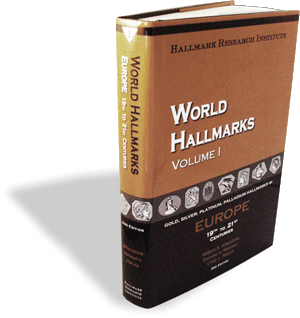
    A trusted dealer can help but if you want to learn to identify jewelry on your own, you’ll need a good guide. There are a few books on the market, but if you want the ultimate, illustrated reference book, be prepared to shell out a couple hundred bucks for World Hallmarks: Europe 19th-21st Centuries, due out in its second printing this month. As co-author Danusia Niklewicz puts it, “This book will pay for itself with one correctly identified piece.”
    I recently spoke to Niklewicz and William Whetstone, who compiled this tome with fellow appraiser Lindy Matula, about the basics of hallmark identification.
    Is it common for people to confuse a maker’s mark with a hallmark?
    - See more at: http://thejewelryloupe.com/jewelry-hallmarks-ultimate-consumer-protection/#sthash.sl6ksAEP.dpuf

    Saturday, December 14, 2013

    Dating Costume Jewelry Can Be Tricky

    It can be tricky at first.  Of course the more you practice, the better you'll be at deciphering the clues.

    Items produced between 1910 and 1990 fall in the "vintage" category.  Items produced before this time frame are "antique" and  items produced after 1990 are called   "contemporary".

    Tips to Remember
    • Aurora borealis rhinestones didn't appear until the mid 50's.
    • Older brooches typically have smooth backs, not patterned ones.
    • Copyright symbols appear on jewelry made from approximately 1950 and on, but not before.
    • Quality vintage rhinestone pieces are usually prong-set.
    • Rhinestones can darken to a gray color with age.
    • Authentic vintage jewelry should show minor signs of wear, particularly in the clasp area.


    You will want to check this link out for some more clues on dating your jewelry.  It's on squidoo and titled Five Easy Clues for Dating Antique or Vintage Jewelry.  But there are more than five clues listed and numerous resources listed.

    Monday, November 7, 2011

    Familiar Jewelry Vocabulary And Some Not So Familiar

    Anodized:  Refers to a method by which metal, such as aluminum, is coated with color by the proces of electrolysis.

    Asterism:  Star-like appearance of star rubies and star sapphires.

    Balas Ruby:  Rose-tinted spinel.

    Chased Design:  Fine lines indented in metal to outline the shap of design motif, used for copper, gold, and silver jewelry.

    Chips:  Tiny, uncut diamonds; sometimes used to surround a larger diamond stone in a ring, also used in the case of a watch, or in a watch band.

    Chromium:  A durable metal, resembles silver, used mainly for plating brass or copper.  Does not tarnish, therefore, has advantage over silver-plated articles.

    Ceramics:  Porcelain, usually hand painted when used in jewelry.

    Coral:  Opaque, rose-pink, ox-blood, white, or yellow in color; the skeletons of sea animals, used for earrings, necklaces and bracelets.

    Ivory:  The hard creamy-white, opaque, fine-grained material of elephant tusks and the tusks of other animals; richly carved for use in jewelry.

    Filagree:  Lace-like jewelry made from wire of silver or gold.

    Engine Turned:  Line engraving applied to plain surface metal by hand or machine from master stencil.

    Hammered:  The surface of metal is maked by small, round hammer marks.

    Jet:  Black, opaque stone of hard-type coal that can be highly polished.

    Mohs' Scale:  The scale used to denote hardness and resistance to scratching .  Ranging from diamond, which rates a 10, down to talc, the stone that is ground and screened for use in talcum powder, rates a 1.

    Mother-of-Pearl:  Iridescent, changeable, mily-white coloring; often carved, is the hard pearly internal layer of the shell of an oyster of other seashell.

    Oxidize:  Term used to designate the darkening pof designs on silver articles by chemicals to gie a richer effect.

    Onyx:  A stone, chalcedony, in parallel layers of different shades of color used especially in making cameos.

    Neillo Engraving:  Fine engraving filled with black enamel or alloy.

    Paste Stones:  Imitation glass stones, usually made of lead glass that has brilliance and sparkle.  Made to imitate real stones.

    Repousse Chasing:  Design raised from the inside, to give molded effect

    Rhinestone:  A stone of glass, cut to resemble a diamond; usually backed with foil to give more brilliance and sparkle.

    Rhodium:  Metal resembling silver, rhodium-plated jewelry wears well; extremely small amounts are plated on fashion jewelry items because rhodium is expensive.

    Rose Cut:  Common type of facet cut: a stone so cut comes to a point at the top and has facets triangular in shape.

    Stainless Steel:  An alloy composed of steel, nickel and chromium; popular for watch cases and under portion of watch bands; for watches worn for sports and other activities.  Wears well, does not tarnish or become discolored.

    Swiss Lapis:  Opaque, dark red quartz stone that is strained blue to resemble Lapis Lazuli for commercial purposes.

    Tenth-Power Loop; Jewelr's magnifying glass that enlarges ten times.

    "Good jewelry is timeless and therefore, one of the best fashion investments one can make.  Don't just purchase jewelry, invest in it."                                                      
                                                                                                                            John Robert Powers