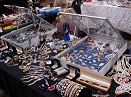
Showing posts with label real or fake?. Show all posts

Thursday, January 16, 2020

Don't Assume Anything When Evaluating Jewelry

image picjumbo
Even the experts have to look closely when examining jewelry. They look to see if there are markings of any kind stamped usually out of sight. The mark can tell a lot about the item. Sometimes the metal content will be revealed, the maker, where it was made and sometimes when it was made.

Wait just a minute. Don't assume just because you can't find any visible marks that it is not valuable. I myself have found a solid gold piece that was not marked, in a thrift store.

I have also found items that were marked gold but were not. Crooks will not stop at anything to get your money. Be aware. Don't assume. Don't invest any money that you can't afford to lose. That would take all the fun out of it. Use common sense. I promise you will come across a treasure of your own some time if you havn't already.

There can be significant value in a well made piece of costume jewelry by the right maker with or without marks also. That is why it is so important to do your research.

I've put together a list of some tips that will be useful on your hunt for treasure.
image pixabay
  • Take your tools like a magnifier or magnet with you when shopping second hand.
  • Waiting for a sale can be profitable on silver and gold pieces of jewelry at the thrift store. D.A.V. thrift stores in my area have 1/2 price sales.
  • Make yourself familiar with the different markings for gold and silver. There are many to consider. Sterling, plated, HGE, 10 K, Plat, Vermeil, etc. 
  • Glass is cold to the touch at first but will warm in your hand as you hold it. 
  • A semi-precious stone will stay cold to the touch.
  • If an opal looks too perfect it is faked. Same size, shape and color in the flecks is a dead give away it's faked. If there are gaps evenly spaced, more than likely fake.  
  • Opals come from Australia. A country of origin mark is a clue for dating purposes.
  • Knowing laws and when they were implemented helps to date items. 
  • Learning when a certain technique for jewelry making was invented will help date an item.
  • Aurora Borealis aka AB was invented by Swarovski and Christian Dior in the 1950's.
  • Russia and Hong Kong create a large amount of synthetic stones.
  • You never want a cloudy gemstone. The richer the color the better.
  • Look at the metal setting around your gemstone. If it is super fancy and outshines your gemstone, it could be over compensating for some where it is lacking. Might be a fake stone. 
  • A real diamond does not fog but fake will.
  • Check weight. A heavy solid construction usually indicates an older more valuable item. But not always.
  • When you look at the back of a piece of jewelry, is it many settings or one solid setting. Separate settings is what you want. If you can look at the back and see that it is just as beautiful as the front you know you have got a really nice piece very well made. 
  • Gold and silver are never magnetic and do not turn skin green.
  • Look for any worn spots that show a different color metal underneath.
  • Learn what tarnished silver smells like. Seriously.
  • The facets will be cut sharp when the stone is authentic. If facets are rounded not so much.
  • The corners or edges of gold jewelry are never sharp. Gold is too soft to form a sharp edge.
  • Mystic topaz and Rainbow topaz are the stone. Vacuum disposition is the treatment used to enhance a clear topaz that is an actual semi-precious stone. 
  • Lots of gemstones are "treated" "enhanced" "heated" or what-not.  
Some of these tips I was aware of already but I have been watching a very informative Dr. Lori on you tube lately. You should check her out. She is smart about all antiques. She educates as she appraises and spices it up with a unique sense of humor that's down to earth. She also has a website packed with tips. https://www.drloriv.com/

I guess my final tip for this post would be to keep educating yourself. Don't be afraid to make a mistake because that is how we learn. Happy hunting! 

Saturday, November 30, 2019

3 Tests 2 Rules 3 Marks Solid Gold Or Plated?

In a perfect world you could trust everybody. Truth to be told, that's just not the case especially when it comes to money. Arm yourself with the knowledge needed to determine the authenticity of any piece of jewelry. You will never get scammed.

Rule #1  Real gold and silver are never magnetic.
Rule #2  Real gold and silver does not turn your skin green.

Test #1
Place the jewelry to be tested in a small stainless steel container. Drop a small amount of nitric acid on the item in a spot that is not obvious. Look for the presence of a reaction and it's color.

  • reaction color is green, your metal is gold plated.
  • reaction color is gold, your metal is brass or gold plated.
  • reaction color is milky, your metal is gold plated over sterling 
  • no reaction at all, you've got real gold.

Test #2

Bleach will not affect real gold. If it's fake the bleach will change the color of the metal it comes into contact with.  Always pay attention when using bleach. It is a strong colorless chemical that can cause damage to most surfaces.

Test #3
One more test to try is the scratch test In an inconspicuous place scratch item in question until you see the metal underneath. A scratch may not be required if corners show wear and reveal the metal underneath.


Item stamped with .417 is the equivalent to 10 K.
Item stamped with .585 is the equivalent to 14 K.
Item stamped with .750 is the equivalent to 18 K.

Thursday, April 27, 2017

Alpaco Stamped Jewelry Vs. Taxco Stamped Jewelry

Taxco Bracelet
Love It!

Taxco Mark
First, groundwork is needed. It has come to my attention that some people are misrepresenting jewelry stamped with Alpaca as sterling silver from Mexico. I don't believe the people describing this jewelry incorrectly, mean to defraud. I'm confident as soon as everyone learns the truth, corrections will happen.

Taxco
Snake Jewelry
This is one possible explanation that resulted in confusion with these marks. Jewelry collectors are familiar with Taxco in Mexico. Taxco and its silver deposits are well known in the jewelry world. Quality silver jewelry produced by artists from Taxco in Mexico are appropriately stamped with some form of the written word "Taxco".  The word itself was a constant, sometimes all caps was used, and variations in the makers mark, if included at all, took many forms through the years. An expert date's the item from these clues in the markings. But, that's the subject for another post.

Taxco de Alarcón Municipality
 located in the 
Mexican state of Guerrero
aka Silver City

What I hope to clarify is jewelry coming from Mexico, stamped Alpaca, is not made from a precious metal. A lot of people are mistaking Alpaca as a city in Mexico. Understandably, they assume since there is a Taxco in Mexico producing sliver jewelry, there must be an Alpaca in Mexico.

Alpaca Mark
on bracelet
Elaborate
Alpaca
Necklace
There is NOT an Alpaco in Mexico. The pieces marked this way are not silver. At least not the precious metal, the .925 sliver coming from Taxco we all think of when we think of silver jewelry. Alpaca is their term for "nickel" silver or "german" silver. Contains no silver whatsoever. Alpaca jewelry is produced as an inexpensive option for consumers unable to afford the actual .925 silver. Alpaca jewelry pieces are equally attractive as their counterparts. Some say they are more attractive because the designers attempt to make up for using the lesser metal alloy. For comparable pieces of jewelry the Alpaca stamped value is less.
Alpaca Bracelet
Follow this link to a superb guide for everything silver, silver plated, makers marks, the works! Alpaca info can be found towards the bottom of the article.

Monday, December 21, 2015

Stamped Markings On Jewelry Defined


SILVER 
925 = Sterling 
Sterling 
Taxco 
MEXICO 

PLATINUM
Pt 
Irid. Plat. 
Pt 900 
Pt 950 
PLAT 


GOLD 

K = Karat ( 14K would be 14 karat etc...) 
KP = Karat Plumb (the manufacturer guarantees it the minimum amount of gold) 

410 = 10K 
585 = 14K 
750 = 18K 
917 = 22K (Asia) 
999 = 24K pure gold (Asia) 

GF  gold filled 

RGP rolled gold plate 

HGE Heavy gold plate 

GP gold plate 

KP Karat Plated 

GS Gold shelled 

EPNS Electroplated nickel silver (german Silver) 


What about KP as in Karat Plumb
In Europe they use KP to signify that there are exactly X parts of gold, so 14KP means that there are exactly 14 parts gold or 58.5% gold.

Gold in the US, prior to October 1st 1981 it was legally allowed to be stamped ½ karat under the actual gold content if no solder was used in its manufacture. If solder was used it could legally be 1 full karat under the hallmarked karat content.

After October 1st 1981 gold jewelry not containing solder could only deviate from its hallmark purity by 3 parts in 1000, and gold jewelry with solder is allowed to deviate by 7 parts in 1000.
It is not legal to hallmark Gold Jewelry made in the US at less than 10K (you will see 9K as an example in England).


Is it K or ct or just a 3 digit number? The ‘ct’ is interchangeable with ‘K’ for karat. The term KARAT refers to the fineness of gold. The word CARAT usually refers to a weight, generally for gemstones but is also used for gold. All a bit confusing, but both are OK to use. The number refers to the fineness of gold in parts per 1000. All these marks are acceptable as it depends on where it was made.
There are many carat amounts used in jewelry. Below are the most common…


  • 8K, 8ct or 333 (parts per 1000) or is 33.3% gold (usually European. Not recognized in USA. The lowest possible standard. Will tarnish sometimes)
  • 9K, 9ct or 375 (parts per 1000) or is 37.5% gold (mainly British Commonwealth countries. Not recognized in USA. Hard wearing.)
  • 10K, 10ct or 416 (parts per 1000) or is 41.6% gold (Minimum USA standard. Hard wearing.)
  • 12K, 12ct or 500 (parts per 1000) or is 50% gold (usually old watch cases. Rarely seen)
  • 14K, 14ct or 585 (parts per 1000) or 58.5% gold (Asian for overseas market. Common in USA. Russian 584.)
  • 15K, 15ct or 625 (parts per 1000) or 62.5 % gold (British Commonwealth countries. Discontinued c1935. A good indicator that the piece is old.)
  • 18K, 18ct or 750 (parts per 1000) or 75% gold. (Most quality pieces are 18ct. Minimum gold standard for sale in Italy.)
  • 22K, 22ct or 916 (parts per 1000) or 91.6% gold (mainly Asia, Middle East. Very soft. Very yellow)
  • 24K, 24ct or 1000 (parts per 1000) or PURE gold (too soft for most jewelry manufacturers)

  • Other countries will designate their gold content by stamping the numbers above into the jewelry.  For example "625" "750" "916".  I came across a ring once that had a three digit marking not like the ones I was use to seeing.  I took it to a jewelry store and found out it was gold.  The place I had acquired it from had processed it as "junk" because they did not know of these different markings.  

    Thursday, November 15, 2012

    Gemstone Or Glass? You Be The Judge

    Today we have standards, regulations and the such to keep retailers honest, or so we like to think.  You can't necessarily say that about earlier times.  An antique jewelry collector must really look at a piece before they can be sure they are getting their moneys worth. 

    A gemstone can be cut and polished into a gem.  When it's set into jewelry, it becomes a jewel.  Antique jewelry can be particularly hard to judge.  For one thing, early diamonds were cut in as few as 24 facets.  When compared with modern diamonds cut to 58 facets, their lack of brilliance might be mistaken as glass.  Here are a few tests that might help in your discoveries.
    1. Touch the stone in question to your tongue and I'll tell you why.  Gemstones (with exception of opal) will remain cool and glass will warm up fast.  This doesn't mean you don't want glass, you just want to make sure your are paying the right price for it.
    2. A drop of water will hold its shape on a real gemstone, but on glass, it spreads out.
    3. Glued stones are likely worth a lot less than the ones held in place with prongs.  So get out your loop and see exactly how the stone was set.  Shining a black light on it will help when trying to determine whether glued or not.  Practice with a black light on different materials.  You might be surprised the things that glow under it.
    4. Your last resort would be to see if the stone will scratch glass.  If it does, it's more than likely genuine, but you have probably damaged the gemstone and now it's worthless.  But at least you know if it is real or not. 
    5. True amber (petrified pitch) is warm to the touch. To test it, heat the end of a pin and apply it to a discreet surface of the amber.  If it's real amber it will smoke and smell like pine.
    Many types of stones, emeralds and rubies in particular, now can be manufactured.  In the collectible market, natural is favored.  Manufactured is not as valuable as natural of course.  It is very hard to tell them apart.  Even trained gemologists sometimes have to remove the stone in question from its setting to figure it out.  They sometimes will determine the authenticity by weighing it. 

    Heat, chemicals and radiation are used on most of the colored stones today to improve their color and smooth out imperfections.  Some color enhancements are not permanent.  Be sure to ask what's been done to the stone before you buy it.

    Deceptive Advertising
    Cape May diamonds, Bohemian diamonds and Herkimer diamonds are quartz.
    Gibson opal and Slocum opal are plastic.
    Girasol pearls, Laguna pearls and Majolica pearls are fake, fake, fake.


    Natural pearls form in oysters all by themselves.  Cultured pearls are seeded and returned to their ocean homes to grow.  Mikimoto pearls is the brand name for a company that started culturing pearls in 1908.  Biwa pearls are cultured freshwater pearls.  Most modern pearls are cultured.
     

    Tuesday, October 25, 2011

    6 DIY Tests For Diamonds REAL or FAKE?

    There are no guarantees with these tests.  But, they just might get you closer to the truth.  Of course, the most reliable source would be an independent appraisal, which would probably cost some money.  Whatever you do, don't let your jewel be taken out of your site.  You could take it to a local jewelry store and get one of their 30 second oppinions for free.  Just know that mistakes can be made with these quick judgements.  With all that said, let's get to what you really came here for, the do-it yourself tests.

    1. It is true that diamonds do scratch glass but so do a lot of the other fakes on the market.  To boot, it is quite possible to injure your rock even if it's real during such a hardness test.
    2. If you flip the diamond upside down and place it over some newsprint and can clearly read through the stone, it's not a diamond.  Some diamonds are cut shallow and can be read through, so this really only works for larger diamonds.
    3. The fog test is a good one.  Put the stone in front of your mouth and fog it like you would try to fog a mirror.  If it stays fogged for 2-4 seconds, it's a fake.  A real diamond disperses the heat instantaneously so by the time you look at it, it has already cleared up.  Oil and dirt on the stone will effect its reliability.  The test is not accurate at all on doublets where the top of the stone is diamond and the bottom is cubic zirconia epoxied together.  Did you know that happens? 
    4. The most popular "fake" diamond is a cubic zirconia.  C.Z.'s weigh approximately 55% more than diamonds for the same shape and dimension.  So if you have a carat or gram scale at your disposal you can see if the imposter tips the scales too much.
    5. A high percentage of diamonds fluorescence blue when put under an ultra violet light (black light).  Since 99% of all fakes don't, a positive identification of medium to strong blue would indicate a diamond.  This method proves you have a diamond.  It also proves your diamond is worth less.  Diamonds with blue fluorescence are as much as 20% less valuable.  Remember, lack of blue fluorescence doesn't mean it's a fake; it could just be a better quality diamond.
    6. If you own some sort of magnifying lens, there are some things you can look for on the stone that might give away its identity.
    •   Look at the rock from the top and see how well the facets are joined.  They should be sharp.
    •   Look at the girdle and see if it is faceted or frosty (clear sign it's a diamond) waxy and slick  (indicates it's a fake). 
    •   While you're looking at your stone under magnification, look into your stone to see if you   detect any flaws (carbon, pinpoints, small cracks).  These are typically clear indications it's the real thing since it's very hard to put inclusions in a fake.
    •   After examining the stone, focus in on the stamps inside the setting.  A stamp of 10k, 14k, 18k, 585, 750, 900, 950, PT, Plat indicates the setting is real gold or platinum which gives a better chance that the stone in it is real as well.  While your're looking at the interior of the ring, also look for any C.Z. stamps.That would indicate the center stone is not a diamond but a cubic zirconia.
    I hope this helps a little bit and I wish you luck on your sluething.

    Wednesday, March 2, 2011

    Easy Tests And Simple Clues - Gold Or Not!

         Pure (24K) gold is too soft to be appropriate for everyday wear; therefore, gold jewelry is made of a mixture of gold and other metals (such as silver, copper, nickel and zinc).  The K (karat) number tells us what fraction of 24 parts of the alloy are pure gold; ie., 14K is 14/24, or 58.33%, pure gold.  The metals used in the alloy also determine the color of the gold; a greater percentage of nickel gives white gold its color, while a high percentage of copper lends a reddish tone to rose gold.  While gold itself does not tarnish, these alloying metals can sometimes cause a piece to darken with time, or leave a dark residue on the skin.  In Europe, gold is marked with a number indicating the gold content as parts per thousand; ie., 18K gold, which is 75% pure gold, is stamped 750.
         If a piece has no markings, there are other clues to help determine the metal.  Look closely at the edges or any place that was likely to rub against things.  Many times small patches of base metal are visible at these points.  If the base metal is white and the piece is yellow gold, obviously not solid gold.  To see brass or copper base metal under yellow is more difficult.
         There is only one true test for gold, and that is done with acid.  A jeweler will perform this test, usually for a fee.  A good gold testing kit can usually be purchased at a jewelry supply store.  The kit comes with everything you need except for the acid, the most important ingredient.  The nitric acid can either be ordered through a pharmacist or purchased premixed at the jewelry supply store.
         Your first step in testing your gold is to find an inconspicuous place on the piece of jewelry in which to file a groove or notch.  This is to get past any layer of gold in a gold filled piece.  Apply a small amount of nitric acid to the area.  If the piece is gold over brass, it will bubble green;  if a bluish color appears, the base metal is copper.  When the piece is 14K gold or better, the acid keeps its clear color.  If, after a few minutes the spot darkens, this is an indication of 10K gold.

         The exact karat can be determined by using the needles that come with the kit.  With these needles a mixture, called Aqua Regis, (one part distilled water, one part nitric acid, and three parts hydrochloric acid) is used.  For those who do not care to invest in a gold test kit, there is a less expensive alternative.  Simply purchase glass acid bottles and premixed testing solution for 10, 14, 18 and 22 karat gold.  You will still determine if the piece is gold by using the nitric acid method explained above.  After the piece has tested as gold, make a mark by rubbing the piece on a test stone.  If the piece is 14K or better and a 14K solution is used, there will be no reaction.  The mark will remain as visible as ever.  Proceed by making another mark and using a higher karat solution until the mark dissolves.  If an 18K solution dissolves the mark and the 14K solution does not, the piece is at least 14K.  After testing, always rinse the piece with a mixture of baking soda and water to neutralize the acid.
         The testing kit (plus acid) is really the only way to find out for sure if it's gold and how much karat.  If you click here or here you'll find other tests and clues used by other folks. 

      31.1 Grams = 1 Troy ounce
    20 Pennyweights (DWT) = 1 Troy ounce


    At 8 AM (CT) the APMEX precious metals spot prices were:
    • Gold price - $1435.70
    • Silver price - $34.86
    • Platinum price - $ 1849.00
    • Palladium price – $822.60
    COMMENTARY: The big news coming out of UBS AG this morning is that China is the big global buyer in gold. Through the first two months of 2011 China has purchased over 200 metric tons of gold. Compare this to a total 2010 consumption of 579.5 metric tons. The spot price is driven by inflation concerns on a global level and in China itself a lack of viable alternative investments.
    In other world news, the Middle East unrest is still dictating safe-haven appeal of gold. With other countries now joining Egypt, Bahrain and Libya the political unrest in the whole region is supporting the appeal of gold.
    The domestic news would appear to be very good since ADP Employer Services estimates show an approximate increase in private sector jobs at approximately 37,000 over original estimates. Ben Bernanke, in testimony before Congress, said there are “grounds for optimism” within the labor market over the coming months.
    Gold spot price is up $3.50 – Silver price is up 36 cents – Platinum spot price is up $2.90 – Palladium price is up $6.30
    APMEX Market Commentary is the resource for the above information.  They also have quite an inventory of gold and silver coins available for purchase.  Definitely worth a look.